History has no control group: the Turkey of 1938 happened once. The Türkiye Simulation is not an attempt to fix that. It is an attempt to make visible the assumptions hiding inside the sentence “what if things had gone differently”.
Anyone who works with data knows the first warning: correlation is not causation. There is a second, less discussed difficulty. When we weigh the consequences of political and economic decisions, we have exactly one observation. We cannot place a Turkey that carried out land reform beside a Turkey that did not and measure the difference. We see what happened. We cannot see what could have happened.
And yet all of us build that counterfactual sentence anyway, in columns, on panels, at dinner tables. The moment we do, we are using a model: a set of assumptions about what leads to what. Usually those assumptions are never stated, never argued over, never tested.
The Türkiye Simulation is our experimental attempt to put them on the table. It is a counterfactual history simulation running from 1878 to 2026: you decide at the country’s turning points, and the country you end up with is placed next to the real Turkey.
How it works
An agenda arrives, chosen to fit the state the country is actually in: the powers of the Ottoman parliament, the Public Debt Administration, land reform, the constitution after the 1980 coup, migration, the presidential system. There are three options, and one of them is the path history actually took. Which one is revealed only after you have chosen. That design choice is deliberate. Seen from the far side of the outcome, a past decision always looks foolish. We want you to sit with the constraints of the period first, and learn what happened second.
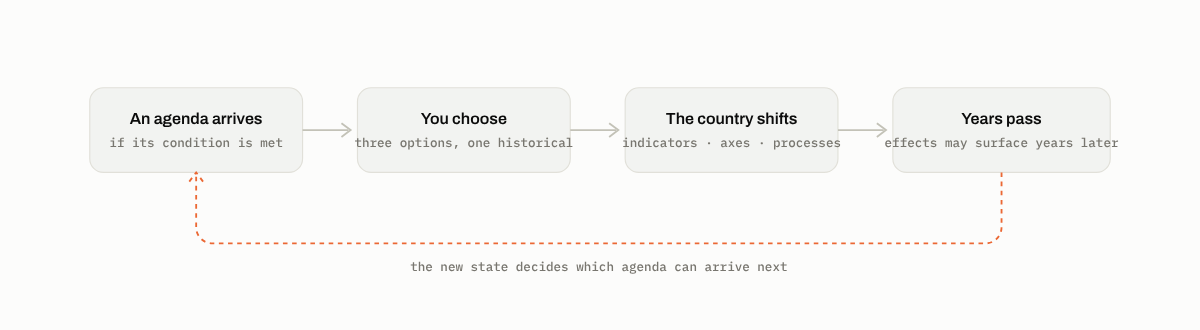
There is a pool of 97 agendas and the sequence is not scripted. If you never moved to multiparty politics, the election debate never opens; without industrialisation, the right to strike never comes up. Two playthroughs do not ask the same questions in the same years. A further 23 agendas never happened at all and are born only in particular branches: if the caliphate was not abolished, a 1934 question about caliphal diplomacy; if there was no coup in 1980, an entirely different constitutional argument in 1982. These junctions have no historical option. They belong to your country alone.
Reading a country through eight indicators

The country is measured on eight indicators: economic prosperity, income equality, rights and rule of law, freedom of association, gender equality, elections and representation, social peace, and state capacity. Alongside them run three orientation axes (statist–market, religious institutions–strict secularism, non-aligned–integrated with the West) and five slow processes that advance largely on their own: urbanisation, schooling, the weight of the military in politics, identity tension, and secular–religious tension.
An option does more than move numbers. It can accelerate a process, pull another agenda forward or close it off entirely, and deliver part of its effect years later. The bill for a decision rarely falls due on the generation that took it.
The moment of decision
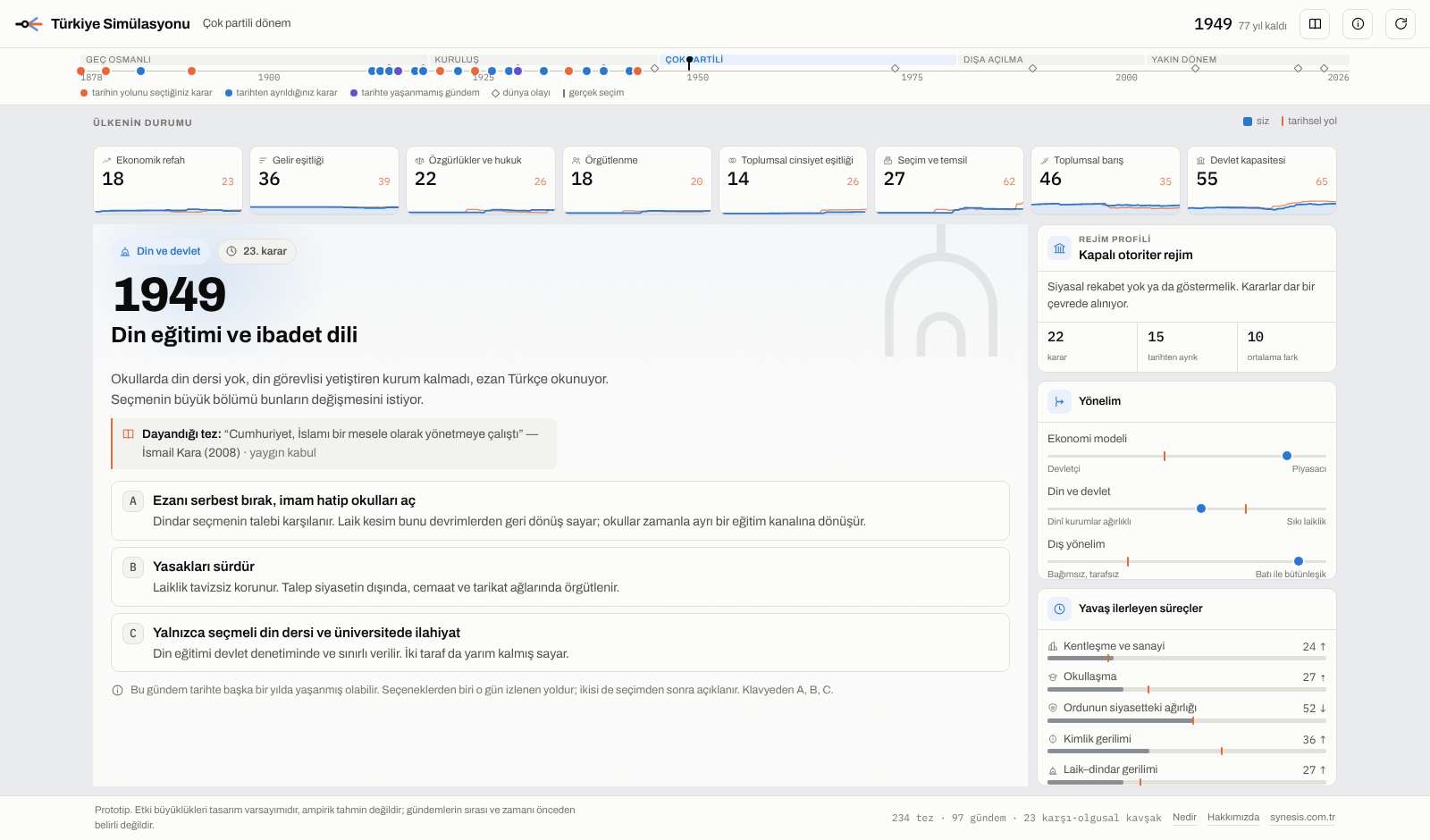
This screen is where the project’s actual claim sits. Above each agenda is the line “the thesis this rests on”. Behind it stands a library of 234 works: from Şerif Mardin’s centre–periphery analysis to Korkut Boratav’s work on distribution, from Deniz Kandiyoti’s patriarchal bargain to Levitsky and Way’s competitive authoritarianism, from Charles Tilly on war and state-making to KONDA’s lifestyle surveys.
Fifty-seven of them are not bibliography. They are rules that run every year inside the model: participation pressure rising as urbanisation and schooling rise, identity tension deepening under repression, welfare provision converting poverty into political loyalty, elections in electoral authoritarian regimes supplying the ruler with information and compliance. These are not arbitrary assumptions. They are named arguments given numerical form, and you can see which of them is operating in any given stretch of years.
Where the model is tested
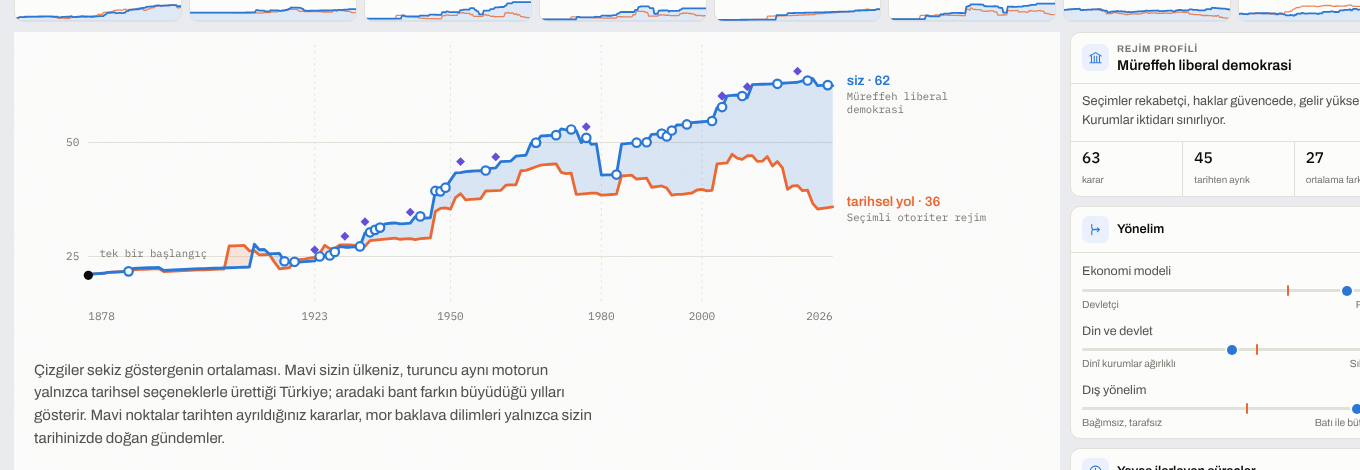
How do you test a model like this? There is one way. If you take the historical option at every junction, the model must arrive somewhere close to today’s Turkey. Across 120 different starting seeds, 118 playthroughs end in the electoral authoritarian family, and the closing indicators sit inside the range suggested by Freedom House, V-Dem and WEF measurements. This does not prove the model right. It is the first sign that it is not wrong. We re-run the calibration after every content addition; when it drifts, the assumption is argued before the coefficient is touched.
What it is not
- Not a prophecy. No option is marked correct and no playthrough is lost.
- Not a forecast. Effect sizes are design assumptions. The literature gives direction, not magnitude, and the model has not yet been calibrated year by year against V-Dem and Maddison series.
- One playthrough is not evidence. There is a lottery inside it; to see a tendency you need to try the same decision across several seeds.
- No option is free. A decision that improves one indicator almost always loads another. If that were not so, the model would be wrong.
Why a research firm builds this
Two reasons. First, writing a model down in the open makes it arguable. You can object to how an agenda is framed, to the effect assigned to an option, or to a junction we left out. At this stage that is what the work needs most.
Second, the simulation is also an instrument. At which junction do most people take the path history took, and at which does almost nobody — we record this anonymously. No personal data, no IP address and no cookies are stored. What accumulates there answers a question no survey can ask: not how people judge the past, but what they do when they have to decide inside the constraints of a period.
About the project
The Türkiye Simulation is an experimental project by Synesis Agora. It covers 1878 to 2026 and contains 97 agendas, 23 counterfactual junctions, 234 scholarly works and 57 operating rules, alongside 416 chronology records from 1923 onward and 49 real election results drawn from the Synesis archive. It remains a prototype, published in order to be argued with. The interface is in Turkish.
Open the simulation →
Longer account: What it is, how it works, how to read it · About